Recognize the signs. Ask the question. Listen with care. Connect someone to support.
You do not have to be a therapist, counselor, or crisis professional to make a meaningful difference when someone is struggling.
NOTICE: Suicide Prevention Skills for Everyday People is a practical, self-paced suicide prevention gatekeeper course designed to help everyday people recognize possible warning signs, start a direct and compassionate conversation, listen without judgment, and connect someone with appropriate support.
In approximately 90 minutes, you will learn a clear, memorable response process that can help you move from uncertainty to action.
You May Be More Important Than You Realize
People experiencing suicidal thoughts do not always reach out to a mental health professional first.
They may speak to a friend, coworker, family member, teacher, coach, supervisor, neighbor, or someone else they trust. Sometimes, they communicate their pain indirectly through changes in behavior, concerning comments, withdrawal, or messages online.
You may notice something before anyone else does.
This course will help you understand what to look for, what to say, and what to do next.
You will not learn how to diagnose someone or conduct a clinical suicide risk assessment. Instead, you will learn how to serve as a gatekeeper: someone who can recognize concern, respond with care, and help connect a person to further support.
The NOTICE Protocol
The course is organized around six practical steps:
N — Notice Signs and Meaningful Changes
Learn to recognize verbal, behavioral, emotional, and situational warning signs that someone may be struggling.
O — Open the Conversation with Care
Learn how to express concern without making assumptions, applying pressure, or sounding judgmental.
T — Talk Directly About Suicide
Practice asking clearly and calmly:
“Are you thinking about suicide?”
You will learn why asking directly is important and how to respond when someone says yes, no, maybe, or does not want to answer.
I — Invite Their Story and Listen
Learn active-listening skills that help people feel heard, respected, and less alone.
C — Connect to Safety and Support
Learn how to help someone contact crisis services, professional care, trusted personal support, or emergency assistance when necessary.
E — Engage Again
Learn why follow-up matters and how to check in without becoming someone’s only source of support.
What You Will Learn
By the end of the course, you will be able to:
- Explain the role and limits of a suicide prevention gatekeeper.
- Identify common suicide warning signs and meaningful changes in behavior.
- Distinguish warning signs from general risk and protective factors.
- Begin a supportive conversation based on what you have noticed.
- Ask directly whether someone is thinking about suicide.
- Respond calmly when someone discloses suicidal thoughts.
- Use active-listening and validation skills.
- Recognize when immediate emergency action may be necessary.
- Help connect someone with crisis, professional, community, and personal support.
- Follow up appropriately while maintaining healthy boundaries.
- Apply the full NOTICE protocol to realistic situations.
Course Curriculum
Module 1: Your Role as a Gatekeeper
Learn what suicide prevention gatekeepers do—and what they are not expected to do.
Topics include:
- The purpose of gatekeeper training
- The limits of the gatekeeper role
- Common myths about suicide
- Respectful and responsible suicide-related language
- Approaching the course with care
Module 2: Notice the Signs
Learn how suicidal distress may appear in someone’s words, actions, mood, routines, relationships, or circumstances.
Topics include:
- Warning signs
- Risk factors
- Protective factors
- New or escalating changes
- Direct and indirect communication
- Cultural and individual differences
Module 3: Open the Conversation and Ask Directly
Learn how to move from noticing concern to beginning an honest conversation.
Topics include:
- Choosing an appropriate time and setting
- Expressing specific concern
- Using calm, nonjudgmental language
- Asking directly about suicide
- Responding to yes, no, maybe, silence, anger, or deflection
- Why you should not promise absolute secrecy
Module 4: Invite Their Story and Listen
Learn how to create space for someone to speak without immediately trying to fix, lecture, debate, or reassure them.
Topics include:
- Open-ended questions
- Reflection and summarizing
- Validation
- Using silence
- Helpful responses
- Common statements that may shut down a conversation
Module 5: Connect to Safety and Support
Learn how to determine the next appropriate action without attempting to conduct a clinical assessment.
Topics include:
- Immediate and life-threatening situations
- Suicidal thoughts without apparent immediate action
- Significant distress without a suicide disclosure
- Contacting 988
- Involving trusted support people
- Connecting with professional care
- Making a warm connection instead of simply giving someone a phone number
- Helping reduce access to immediate danger when it is safe to do so
Module 6: Engage Again
Learn how continued contact can reinforce connection and help someone follow through with support.
Topics include:
- Planning a specific follow-up
- Checking whether support was accessible
- Responding to barriers
- Maintaining privacy and appropriate boundaries
- Caring for yourself after a difficult conversation
Module 7: Put NOTICE Into Practice
Apply what you have learned through realistic, interactive scenarios.
Practice situations include:
- A friend struggling after a painful loss
- A coworker whose behavior has changed
- Someone posting concerning content online
- A person who denies suicidal thoughts despite ongoing concern
- A person who asks you not to tell anyone
The course concludes with a final knowledge assessment and a personal action plan.
Course Format
This course is designed to be practical, focused, and easy to complete.
Estimated completion time: 80–100 minutes
Format: Self-paced online learning
Lessons: Short video or written lessons, examples, knowledge checks, and scenarios
Assessment: Final course quiz
Access: Complete the lessons on your own schedule
Certificate: Certificate of completion available after successfully completing the course requirements
You may pause the course and return to it later.
Included Course Resources
Your enrollment includes downloadable tools you can continue using after the course:
- NOTICE Quick-Action Guide
- Suicide Warning Signs Reference Sheet
- Starting the Conversation Phrase Bank
- Helpful and Unhelpful Responses Guide
- Crisis Connection Decision Guide
- Local Support Map Worksheet
- Active-Listening Practice Sheet
- Follow-Up Checklist
- Scenario Practice Workbook
- Course Reference and Resource Guide
These resources are designed for both digital use and printing.
Who Should Take This Course?
NOTICE is intended for adults who want to feel better prepared to respond when someone may be struggling, including:
- Friends and family members
- Coworkers
- Managers and supervisors
- Teachers and school staff
- Coaches and athletic staff
- Volunteers
- Faith and community leaders
- College students
- Peer supporters
- Human resources professionals
- Youth-serving professionals
- Members of LGBTQ+ organizations and community groups
- Anyone who wants practical suicide prevention skills
No previous mental health education or professional experience is required.
What This Course Does Not Do
NOTICE is a public education and gatekeeper-training course.
Completing this course does not qualify a participant to:
- Diagnose a mental health condition
- Conduct a clinical suicide risk assessment
- Provide therapy or crisis counseling
- Replace emergency, medical, or behavioral health services
- Act outside applicable laws, workplace procedures, professional responsibilities, or mandatory-reporting requirements
The purpose of the course is to help participants recognize concern, respond supportively, and connect people with appropriate help.
Why Take NOTICE?
Many people hesitate during difficult conversations because they are afraid of saying the wrong thing.
They may wonder:
- What if I am overreacting?
- What if asking about suicide makes things worse?
- What am I supposed to say if the person says yes?
- When should I call 988?
- When is the situation an emergency?
- What if the person refuses help?
- What if I am not a mental health professional?
NOTICE provides a clear process for navigating these moments.
You may not be able to solve everything someone is facing. You can notice. You can ask. You can listen. You can help them reach the next source of support.
Those skills matter.
Certificate of Completion
Participants who complete all required lessons and successfully pass the final assessment will receive a downloadable:
Certificate of Completion
NOTICE: Suicide Prevention Skills for Everyday People
This certificate documents participation in suicide prevention gatekeeper education. It does not represent clinical certification, professional licensure, or qualification as a suicide risk assessor or crisis counselor.
Before You Begin
This course discusses suicide, suicidal thoughts, emotional distress, and crisis situations directly.
Please take care of yourself while participating. You may pause, step away, or return to the material later.
If you are currently experiencing suicidal thoughts or are concerned that you may not be able to remain safe, this course is not a substitute for immediate support.
In the United States, call or text 988 to reach the 988 Suicide & Crisis Lifeline.
If there is an immediate or life-threatening emergency, call 911 or go to the nearest emergency department.
Be Ready to Notice. Be Ready to Ask. Be Ready to Help.
A caring conversation cannot solve every problem.
But it can interrupt isolation.
It can create an opening.
It can help someone reach support.
Enroll in NOTICE: Suicide Prevention Skills for Everyday People and learn practical skills for responding when someone may need you most.
Curriculum
- 8 Sections
- 25 Lessons
- 52 Weeks
- Module 1: Your Role as GatekeeperMost people who help in a suicidal crisis are not therapists. They are friends who notice a message that feels different, coworkers who ask about a change, family members who stay on the phone, teachers who take a comment seriously, supervisors who know the referral pathway, and community members who help someone reach care. That is the gatekeeper role: notice, respond, and connect. It is both smaller and more important than “solving” another person’s crisis. A gatekeeper does not need certainty. A gatekeeper needs enough concern to begin a direct, caring conversation and enough preparation to help the person reach the next safe layer of support. The 2024 National Strategy for Suicide Prevention describes suicide prevention as a whole-of-society effort and emphasizes community partnership, crisis care, health equity, and the role of people with lived experience. Gatekeeper skills belong inside that larger system; they are not a substitute for it (HHS, 2024).3
- Module 2: N - NoticeNoticing is not the same as monitoring every person for a secret checklist. It is paying attention to what a person says, what they do, what has changed, and what is happening around them. The strongest cue may be a direct statement. It may also be a cluster of smaller changes that becomes concerning in context. The purpose of noticing is not to label someone. It is to recognize when a caring, direct check-in is warranted.4
- Module 3: O + T - Open and Talk DirectlyOnce you notice concern, the next challenge is beginning. People often delay because they fear awkwardness, anger, denial, or saying the wrong thing. A simple structure reduces that hesitation: Observation + care + invitation. Then, if suicide is a concern, ask the direct question. You do not need to build a perfect speech first.3
- Module 4: I - Invite and ListenAfter asking about suicide, a gatekeeper may feel pressure to fix the situation immediately. That pressure can lead to rapid advice, reassurance, interrogation, or a speech about reasons to live. Listening is not passive, and it is not a delay before the “real” intervention. It helps the person feel less alone, gives you information needed for the next safe action, and makes connection to help more collaborative. The aim is not to approve of suicide or agree that there is no hope. The aim is to understand the pain well enough that the person does not have to defend it before accepting support.2
- Module 5: C - Connect to Safety and SupportRecognition without a next step leaves a gatekeeper underprepared. This module answers the practical question: What do I do now? The answer depends on the immediacy of the situation, but the gatekeeper does not need to assign a prediction such as “low,” “medium,” or “high risk.” Those labels can create false reassurance or false certainty and belong, if used at all, inside carefully reviewed professional frameworks. The gatekeeper instead identifies the next safe action. Three broad response pathways organize the decision: 1. Immediate danger: emergency action is needed now. 2. Current suicidal thoughts: prompt, active connection is needed during this interaction. 3. Significant concern: support and follow-up are needed even without disclosed current thoughts. When the situation is unclear, choose the more supportive response and consult 988 or an appropriate professional.5
- Module 6: E - Engage AgainA crisis conversation can feel like a single dramatic moment, but connection after that moment matters. A person may encounter a waitlist, miss a call, feel embarrassed, minimize what happened, or lose momentum once the immediate intensity changes. Follow-up communicates that the person matters beyond the emergency and helps identify whether the referral actually worked. Follow-up does not mean becoming responsible for another person every hour of every day. Effective gatekeeping includes both continued care and clear boundaries.2
- Module 7: Putting NOTICE Into PracticeKnowing the letters is not the same as using them in a tense moment. In this scenario lab, you will practice choices at several decision points. The goal is not to produce a flawless script. It is to recognize the strongest next move and understand why weaker options can close the conversation or delay safety. The scenarios are fictional composites. They avoid graphic detail while reflecting common gatekeeper situations.2
- NOTICE Course Resources7
Certificate
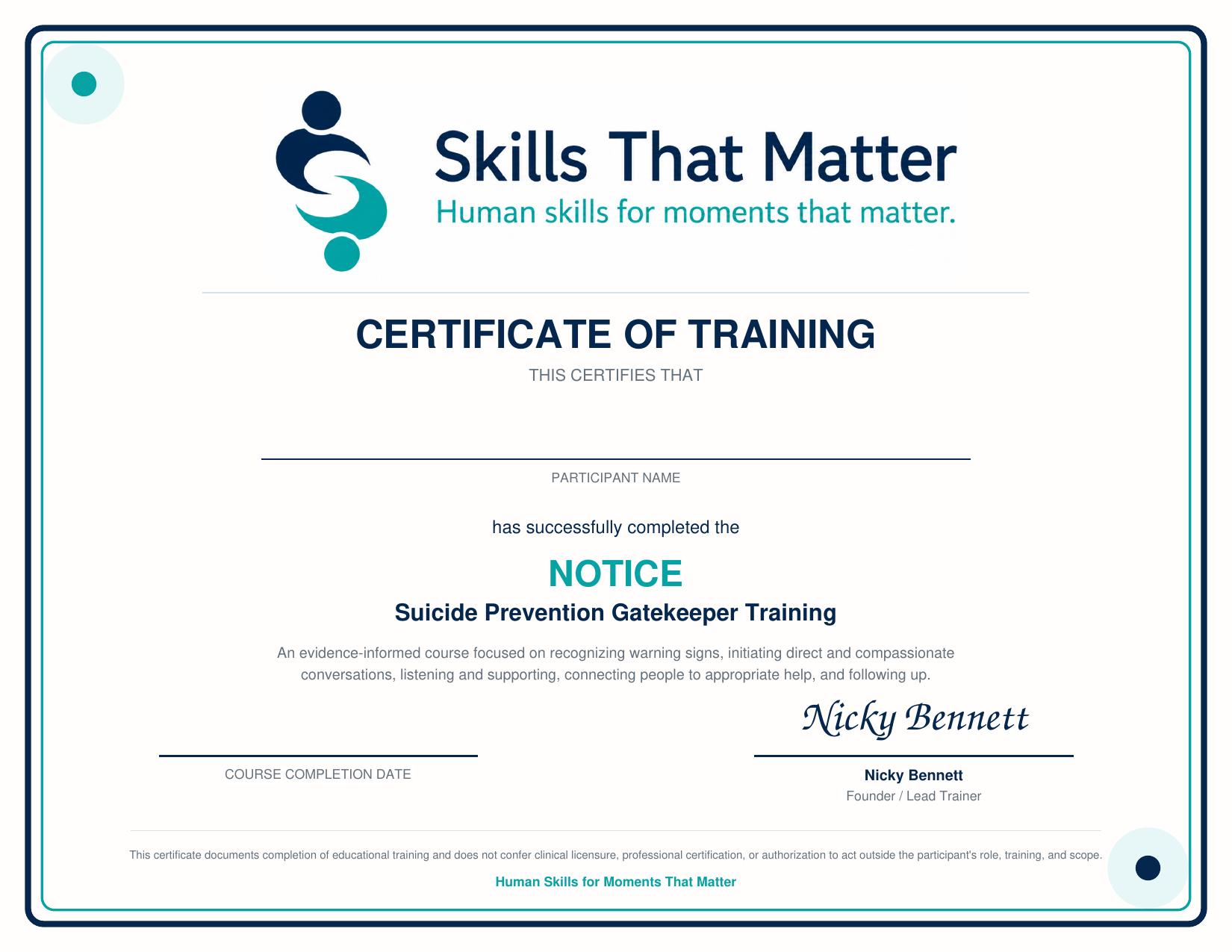
Earn a Certificate & Showcase Your Skills
Instructor